Step-by-Step Guide to the TAVI Procedure
Transcatheter Aortic Valve Implantation (TAVI) is a modern, minimally invasive heart procedure used to treat severe aortic stenosis — a condition where the heart’s aortic valve becomes too narrow to allow proper blood flow. Traditionally, patients required open-heart surgery, but TAVI offers a safer and faster alternative, especially for elderly patients or those with high surgical risks.
Step-by-step guide to understand what happens before, during, and after TAVI.
1. Initial Evaluation and Diagnosis
Before TAVI is recommended, your Best Cardiologist in Jaipur will conduct a thorough assessment to confirm the severity of your aortic stenosis. This may include:
- Echocardiography (Echo) to check heart valve function
- CT scans to examine the aorta and arteries
- Blood tests and medical history review
If TAVI is deemed suitable, your doctor will explain the risks, benefits, and procedure plan.
2. Pre-Procedure Preparation
A few days before the procedure:
- You may need to adjust or stop certain medications.
- You’ll undergo routine health checks.
- Fasting is required for several hours before TAVI.
Your TAVI Specialist in Jaipur, Dr. RudraDev Pandey, will ensure you are well-prepared and comfortable before the procedure day.
3. Anaesthesia and Access Site Preparation
On the day of the procedure:
- Local anaesthesia with sedation or general anaesthesia is administered.
- The most common access site is through the femoral artery in the groin, but other access points may be used depending on your condition.
4. Insertion of the Catheter
- A thin tube (catheter) is inserted into the blood vessel.
- The catheter is guided to the heart using real-time imaging.
5. Valve Placement
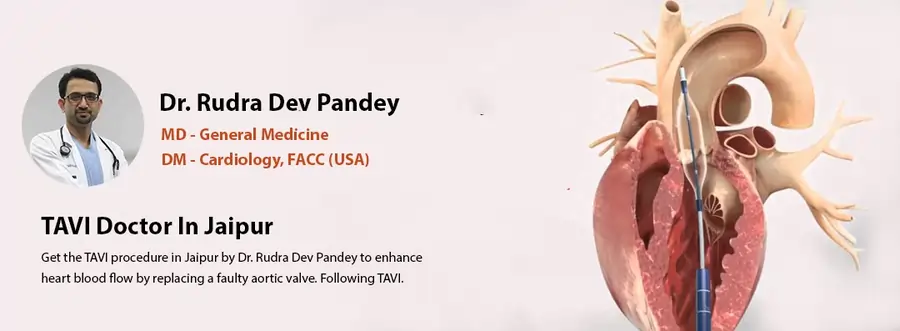
- The replacement valve is compressed onto a balloon or self-expanding frame and delivered via the catheter.
- Once positioned inside the narrowed aortic valve, it is expanded to push the old valve leaflets aside.
- The new valve begins functioning immediately.
6. Removal of Catheter and Closure
-
The catheter is carefully removed.
-
The access site is closed, and you may have a small dressing or bandage applied.
7. Post-Procedure Recovery
-
You’ll be monitored in a recovery unit or ICU for 24–48 hours.
-
Most patients are discharged within 2–5 days.
-
Light activities can be resumed in a week, but strenuous activity should be avoided until cleared by your doctor.
8. Follow-Up Care
-
Regular follow-up appointments are essential.
-
Your doctor may prescribe medications to prevent blood clots and protect heart function.
-
Lifestyle changes, such as a heart-healthy diet and gentle exercise, can help maintain your results.
Why Choose Dr. RudraDev Pandey for TAVI in Jaipur?
With extensive experience and advanced training, Dr. RudraDev Pandey is a trusted TAVI Specialist in Jaipur known for delivering precise, safe, and patient-focused care. His expertise ensures that patients receive world-class treatment with minimal downtime and maximum comfort. TAVI is a life-saving option for many who are unable to undergo traditional heart surgery. By understanding the step-by-step process, you can feel more confident and prepared for the journey to better heart health.